The permit: who issues it, and where the line is
Start with the fact most quotes skip. The City of Visalia Building & Safety Division requires a plumbing permit to install, remove, replace, raise, lower, or relocate a water heater (citing California Plumbing Code 502.1), with a final inspection after the work is complete. That is the City of Visalia's own water heater handout (verified 2026-09-13), and it does not carve out like-for-like swaps: "replace" is on the list. The permit is issued by the Building Division at 707 W. Acequia Ave., Visalia, CA 93291, 559-713-4300.
Whether the city or the county is your permitting office depends on the parcel, not the mailing address. A Visalia mailing address can sit outside the city limits, and then the office changes. Building permits for unincorporated Tulare County go through the Resource Management Agency Permit Center, which accepts applications online through its Citizen Self-Service portal. source The county Permit Center is at 5961 S. Mooney Blvd., Visalia, CA 93277, 559-624-7000, open Monday–Friday, 9:00 a.m. to 4:30 p.m. If you are not sure which side of the line you are on, either office can tell you from the address in one call.
Because the permit is required, the job is licensed work at any price: California's handyman exemption fails on its own as soon as a permit is involved, which the licensed-plumber guide covers in full. In practice, the licensed C-36 plumbing contractor pulls the permit as part of the job and schedules the final inspection — a quote that leaves the permit out is a quote to ask about. The Visalia water heater repair and replacement cost guide shows where the permit, straps, and expansion tank sit inside a typical $1,500–$3,000 installed price, and the emergency plumber page covers the leaking-tank-at-night version of this job, where the permit is still required but the shutoff comes first.
Seismic strapping: state law, not a Visalia quirk
The second rule is statewide and older than most people assume. California Health and Safety Code §19211 requires all new and replacement water heaters, and all existing residential water heaters, to be braced, anchored, or strapped to resist falling or horizontal displacement from earthquake motion, installed at a minimum to the California Plumbing Code or any stricter local rule — and it requires a seller of real property with a water heater to certify in writing to the buyer that the section has been complied with. source Three things follow from that wording. The law reaches existing water heaters, so an unstrapped tank in a 1980s Visalia garage is non-compliant today. It sets the California Plumbing Code as the floor and lets cities adopt something stricter. And it puts a written certification on every home sale, which is where most unstrapped tanks are finally caught.
The Plumbing Code rule itself is short. The California Plumbing Code requires water heaters to be strapped at two points — one within the upper third and one within the lower third of the tank — with the lower strap kept at least 4 inches above the controls, as restated in California building-department water heater handouts (e.g., City of Roseville, revised January 2026). source The state's own illustrated guidance goes a step further on how to do it: The Division of the State Architect's bracing guidelines (rev. 2004) call for a minimum of two sets of straps anchored into wall studs with lag screws, a third set at mid-height on tanks up to 75 gallons, local building-department approval for anything larger, and strongly recommend flexible connectors on the water, gas, and electrical lines. source The common thread in every official version is the anchor, not the strap — a strap screwed into drywall with no stud behind it meets the letter of "two straps" and does nothing in an earthquake, and it is the first thing a final inspection checks.
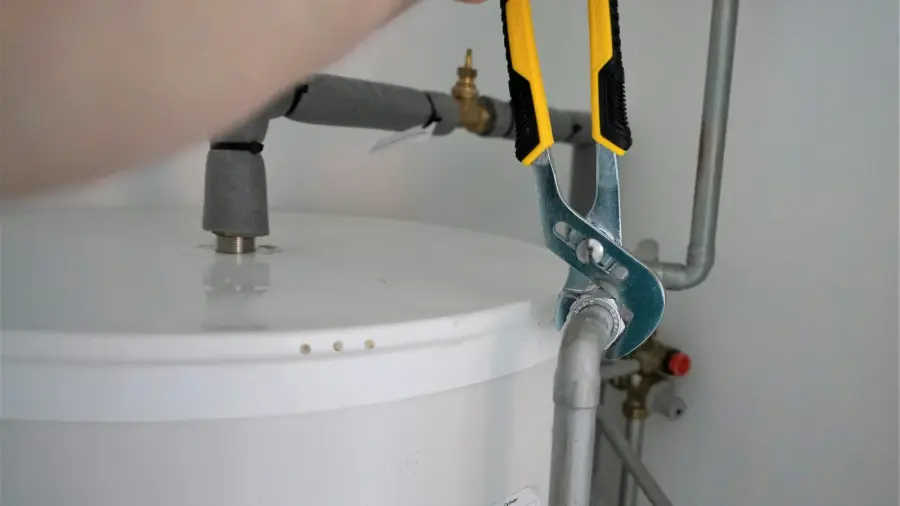
What the final inspection actually checks
Visalia's permit comes with a final inspection, and the inspector works from the same list every California building department publishes. Knowing the list is the easiest way to read a quote — the items on it are the "extras" a bare swap price leaves out.
- Straps and anchors. Two straps, upper and lower third, lower one clear of the controls, lag-screwed into studs or properly anchored into masonry. Loose, single, or drywall-only strapping is a correction.
- The T&P relief line. California building-department handouts restating the California Plumbing Code require the temperature-and-pressure relief line to run full size, untrapped, to an approved location outside, ending 6 to 24 inches above the ground, pointed down, with no threads or cap on the end and no valve between the relief valve and the tank; an expansion tank where the house has a closed system; and a drain pan with its own drain where a leak would cause damage — and they prohibit draining the relief valve into the pan. source On an older Visalia install the relief line often ends in a bucket, runs uphill, or was capped to stop a drip — each is a correction, and the capped one is a safety problem, because a capped relief valve cannot relieve anything.
- Expansion tank. Where the house has a pressure regulator, backflow device, or check valve on the supply, the system is "closed" and heated water has nowhere to expand; the code calls for an expansion tank, and a dripping T&P valve on a tank that is otherwise fine is the usual symptom of not having one.
- Drain pan. Required where a leak would damage the house (an interior closet, an attic, a second floor), with its own drain line to an approved place — and the relief valve may not discharge into it.
- Garage placement. On a gas unit in a garage, the burner and ignition source sit at least 18 inches above the floor, and the tank is protected from vehicle impact where a car could reach it.
- Gas and venting. A shutoff on the gas line, a listed flexible connector, and a vent run with the right clearances and termination — the items that make a gas water heater a licensed job in the first place.
Two of those items deserve a separate note because they are the ones most often done wrong on an existing tank: the strapping, which the Legislature's own findings in the same statute admit fell short of its goal of every water heater strapped by 2000, and the relief-line termination, which is routinely improvised. If your current tank fails either one, it is still a permit-free fix in the sense that no new tank is involved — but it is the fix an inspector will want to see done before signing off a replacement next to it.
Earthquake gas shutoff valves
A seismic gas shutoff valve closes the gas supply to the whole house when it senses strong shaking, and it is often sold alongside a water heater install. The Division of the State Architect certifies earthquake-actuated gas shutoff valves under Health and Safety Code §§19180–19183, but states that installation "is under the jurisdiction of the local building departments" — whether one is required on a given house is a local question, not a statewide rule. source This site could not find a published Visalia or Tulare County requirement on either agency's pages. If a plumber tells you one is required, ask which code section; if you want one anyway, ask for a DSA-certified model and have it added to the same permit so it is inspected with the rest.
If you are not replacing anything
Nothing above requires you to replace a working water heater. It does mean an existing tank should be strapped now — the law applies to it as it sits — and a sale will force the question in writing. Strapping an existing tank is a small job a plumber can fold into any other visit; a homeowner can also do it, following the state's illustrated guidelines linked above. The one thing not to do is strap it badly and call it done. If the tank is leaking rather than merely unstrapped, the repair-or-replace test settles the next step; if water is coming from a supply line or the wall rather than the tank, the burst pipe repair page is the right one.
Before you sign the estimate
- The permit is a line item, pulled in the contractor's name, with the final inspection scheduled by them.
- Seismic straps, T&P discharge line, drain pan (where needed), and expansion tank (where needed) are listed in the price, not offered as add-ons after the tank is in.
- The CSLB license number is printed on the estimate. Check it at cslb.ca.gov for an Active status and a C-36 classification — the how we match plumbers page walks through it in a minute. Companies we pass requests to report holding an active California CSLB C-36 Plumbing Contractor license and insurance. Verify any contractor yourself at cslb.ca.gov before hiring.
- The price sits inside the ranges on the Visalia plumbing cost guide; if it is well above, ask which of the items above is driving it.
About this page
The permit rule is cited to the City of Visalia's water heater handout (VIS-004, verified 2026-09-13); the county office to Tulare County RMA's own permit pages; the bracing law to the statute text published by the California Seismic Safety Commission; strap placement and relief-line rules to the California Plumbing Code as restated in a California building-department handout and the Division of the State Architect's bracing guidelines; the gas-valve point to DSA's certification page; and the contractor's permit duty to CSLB's permit-violation referral form — each with a verification date in the site's facts file. This page deliberately states no permit fee, no inspection turnaround, and no Visalia-specific strap detail, because none could be confirmed from the city's own document during this update. It is not legal advice; a specific question about your parcel is answered by the Building Division at 559-713-4300 or the county Permit Center at 559-624-7000.